Friday, April 30, 2010

Podcasting


   During our lecture on Podcasting, I was inspired to create my own. I have no idea what it would be about, but I know that I would probably talk people to death. I really enjoyed our lecture because it highlighted how to start a podcast as well as the many different websites that facilitate a podcasts creation and management. However, the most interesting part of the lecture was the discussion we had on the importance of podcasts.
    In my opinion the podcast in the university setting is an amazing development. I feel that if professors were more adept at using podcasts for their classes, students would be much more productive and directly improve their grades. For example, in the psychology department, we have a class called research methods and statistics. It is a two semester class that includes a lot of calculation and very little concepts. It is true that we have a book and have lecture three times a week, but during lecture we cannot focus so much on what we're learning because we are feverishly taking notes. If we had the knowledge that we would have a podcast of everything the professor explained, we would have more time to fully take in what she was explaining and then be able to take notes on the specifics during our own time. I feel that many people ignore the value of going over the specifics of what professors say. A lot of the time students are tested on obscure statements made by professors. If professors used podcasting the students could go through the lectures with a fine tooth comb to discover what is and isn't important. Podcasting would also be an amazing tool at bigger schools where one on one time with professors is impossible. I know that if all of my psychology professors employed the use of podcasting, I would be an extremely happy student. 

Twitter: To Tweet or Not to Tweet

http://www.freemarketmediagroup.com/internet-marketing/wp-content/uploads/twitter_bird_follow_me.jpg


I have become addicted to Twitter. The idea of being able to send out my most random thoughts into the technological world is extremely enticing and exciting. I am no longer the passive audience member, I am the producer of my own news. I find that using Twitter is such a phenomenon that its practices get translated into normal activities. I find that during a socially tragic conversation I will say "#fail", knowing very well that the hash-tag is doing nothing in face to face conversation. This was one of the indications that I had become addicted.
Now that I can admit my addiction, which is the first step, I can move on to examining the source of this attachment to tweeting. It is extremely important to recognize the limitations of free speech on Twitter. Last month it was announced that all tweets would be archived by Congress and this new development is extremely frightening. You begin to wonder, "what did I tweet about during the Grammy Awards?" or even "what did I tweet when I was upset with someone?". The question then becomes, to tweet or not to tweet. I believe that all people should be aware of what they are putting on the internet. They should monitor their speech and make better decisions about what is appropriate and what is not appropriate. Should you tweet about what you did last night if it is unacceptable behavior? Should you tweet your every thought and action? No! You shouldn't. While tweeting I try to practice discretion and tact. Everyone should acknowledge the fact that nothing you put on the internet is private, and nothing disappears. It doesn't go to a black hole of internet information, it stays for perpetuity. Remember, its not tweets that ruins lives, its irresponsible tweets that ruin lives.

Monday, April 12, 2010

Second Life


Second Life is a very interesting and engaging social site. After you get used to it, you can see why some people find it addicting. Before logging in, I was very nervous about using the site because I had no idea what I was supposed to do. I was confused as to how I would interact with others and make my way in the virtual world. I was ecstatic when I arrived at Orientation Island because it helped to explain the ins and outs of Second Life. I found out that you communicate through scripts and discovered the different types of sims I would be able to interact with.
The Second Life world is really interesting for the simple fact that most people behave in the way they would normally. They interact as if they were in the real world and not a virtual world. Because of this I don't quite understand why people would trade reality in for a virtual one. For the most part people seem to behave normally and are still bound to the attitudes and behaviors of our society. I would have assumed that Second Life would be full of chaos because of the limitless possibilities of behavior. Although there are griefers within Second Life, they don't affect game play too much. They seem to be in the minority as well, because most people behave normally.
As for using Second Life, it got rather complicated and a little frustrating. I think if they made the programming a little bit easier, I would have been more interested. Overall, I don't see myself being a frequent user of the site just because I prefer face to face human contact.

Wednesday, April 7, 2010

Growing Up Online

http://kiwicommons.com/wp-content/uploads/2009/08/Special-Teens-and-the-Internet-300x199.jpg
In the video "Growing Up Online", the impact of the internet on the lives of teenagers is discussed. The video seemed to over-exaggerate the fact that teenagers live their lives with the internet as an extension of it. I personally feel that the so called addiction that young people seem to have with the internet has developed because of the internet's ease. It is extremely easy to do research online, to connect with people online, and to be entertained online. The adults in the film discussed the internet as if it was a plague to the lives of teenagers, when in fact, it is a priceless tool that improves the lives of teenagers. I am not one of those people that uses my desktop or laptop religiously, however, I often use my Blackberry for Twitter, Facebook, email, and general research. I have everything I need at my fingertips and that makes me more efficient overall. For example, I find out things necessary for class and can plan accordingly.
I think the problem with the internet arises when teenagers completely shut out reality in exchange for a virtual one. You can't spend all of your free time on the internet because you are missing out on true interaction which is beneficial to all humans as well as exercise which is beneficial as well. What is important is for teenagers to strike a balance between using the internet and living life.

Monday, March 29, 2010

Wikis

    
http://cc-site-images.s3.amazonaws.com/Video-Previews/Wiki.jpg


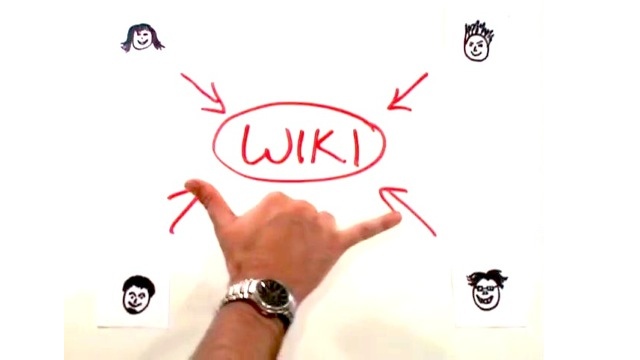
     Wikis, as explained in the "Wikis in Plain English Video", are used in order to coordinate between people. It is supposed to be better than coordination through email because it allows everyone to participate and edit information. It would be extremely helpful for large groups who are trying to collaborate simultaneously. It is faster and ensures that all of the participants can view all the changes. With email, one must open the group of emails and compare dates received in order to discover what the plans are.
     For my future career in sports, I feel that a wiki would be extremely helpful. In terms of collaboration, there could be many sports journalists covering one event and displaying new forms of information. With this collaboration, sports stories would be better covered and perhaps more in depth. The idea of the stories being more in depth and better covered would completely benefit the public, which is what journalism is for. I would be interested to see how a wiki for sports journalists would help or hinder the field.
        By moving towards wikis, sports journalists could further their stake in new new media. By moving towards new new media, they could increase their audience base. Although this form of journalism is almost exclusively entertainment based, I feel that the information should continue to follow the methods of journalism. The use of wikis could facilitate this goal.

Monday, March 22, 2010

Bloggers and Freedom of the Press

http://www.merinews.com/upload/thumbimage/1214210664679_freedom%20of%20press.jpg
http://www.cartoonstock.com/newscartoons/cartoonists/ksc/lowres/kscn1375l.jpg
       I think that the idea of Freedom of Press within the blogging world is a  major issue. It is rather confusing to distinguish between a journalist and a blogger because many people feel that they do the same thing. They both intend to inform an audience and they both work for the people. Because these two groups hold the same intentions, it seems as though they should be afforded the same rights. These rights include the Shield Law, which prevents journalists from being obligated to reveal their sources, as well as a type of freedom from government interference.
       Is it fair for bloggers to be on the outside of these benefits? I personally feel that it isn't. It seems to me that bloggers should be afforded the same rights as journalists because overall they must have a passion for spreading information. If you contrast a blogger with a journalist you can see that one is driven by a paycheck, while the other is driven by their intense desire to inform/entertain. It seems that the power is shifting and that people are now more open to the information presented in blogs than information presented by big news corporations. The fact that advertising is entering the arena of blogging is somewhat causing its reputation to be tarnished, however, not as much as the reputation of big journalism corporations.
        In terms of applying Freedom of the Press to my future occupation of sports journalism, I would attempt to enforce the importance of blogging within the realms of sports. If I were to not be afforded a job within a major news corporation such as ESPN, I would attempt to inform true sports fans about major controversies within the realm of sports. Such controversies to explain could be steroid use and even fraud among sports officials. I feel that having a blogger explain all of these controversies would be better for a sports audience because it means that as a blogger I can state facts without fear of being repremanded. Overall, this goes into the aspect of bloggers having more of a stake in facts and it also goes back to independence from faction.
        People are more likely to trust bloggers on a variety of different topics because they don't have anything to lose, whereas, journalists could lose their jobs. I really think this major difference between these two types of "informers" is what makes it so important that bloggers are afforded Freedom of the Press. The job of protecting citizens and informing people about occurrences within society has shifted to bloggers, and because of that, they should have the rights that are afforded to journalists.
        

New New Media

http://blogs.worldbank.org/files/governance/image/blog%20board.jpg


I am very interested in the aspects of new new media. Since we've discussed it in class, I have come up with the idea of creating a blog for my sorority. The fact that it will be separate from any major news corporation, as well as the fact that it will be run by the members of my chapters sorority, solidifies its new new media qualities. New New Media is complex in the sense that its information does not have to be strictly news based. It also doesn't have to follow the format set out by big news corporations, hence its appeal.

I feel that in order to make a blog successful it has to first entertain people, whereas in news, I feel that informing is more important than entertaining. I also feel that it is important to gage the interest of your readers by allowing them to comment and to suggest new story ideas. This would increase the popularity of the site while at the same time challenge the writers to do stories that may be out of their comfort zones.

In conclusion I would like to say that New New Media is a very important wave of mass media. It encompasses the importance of the individual as well as the importance of reader support. I think creating a blog in this class has opened my eyes to that fact.